Respect at Work Has to Go Both Ways
Louis Carter explains why workplace respect must flow among employees, managers, and leaders, and why retaining effective managers matters.

Respect at work is a shared obligation. Leaders must listen, communicate honestly, keep commitments, apply standards fairly, and protect employees from humiliation or retaliation. Employees must also communicate honestly, meet commitments, raise concerns professionally, and treat managers and coworkers as human beings. Leaders hold more formal power, so they carry more responsibility for the environment. That difference in authority does not make respect a one-way obligation.
I have spent more than 25 years studying workplace culture and working with leaders and employees. One pattern has held up across organizations: people form a stronger emotional connection to work when they feel respected and when respect is expected from everyone.
The trouble starts when a company treats respect as something management is supposed to hand down. A workplace cannot build trust when leaders dismiss employees or punish candor. It also cannot sustain trust when employees withhold important information, ignore reasonable commitments, undermine managers, or treat coworkers with contempt. Culture is created through all of those relationships, not only through the behavior of the person at the top.
Get your free Opportunity Report
See your eligibility score, the certifications you may qualify for, and what candidates and AI search engines find when they look you up. Takes about 60 seconds.
What Emotional Connection at Work Means
At Best Practice Institute, our Most Loved Workplace® research defines emotional connectedness as a relationship with work that goes beyond satisfaction or a transactional attachment. It includes belonging, psychological safety, loyalty, initiative, and a sense that personal effort is connected to a worthwhile shared future.
We developed the Love of Workplace Index through research involving more than 3,600 participants. The instrument includes 28 quantitative questions across five areas: systemic collaboration, a positive vision for the future, alignment of values, respect, and killer outcomes. Our researchers also manually coded nearly 4,000 excerpts from employee responses to identify recurring sentiments, emotions, topics, and themes , per the Most Loved Workplaces profile.
There is an important detail in that research. The qualitative framework includes both employee accountability and leadership accountability. That is intentional. Emotional connection weakens whenever one group is expected to carry all the responsibility for making the relationship work.
Our 2025 Most Loved Workplace research deck also describes a broader culture intelligence approach that combines employee sentiment, predictive insight, and benchmarking. The point is not to generate another score. It is to see whether people experience respect consistently across teams, roles, and levels, and then act on what the evidence shows, per the Most Loved Workplaces profile.
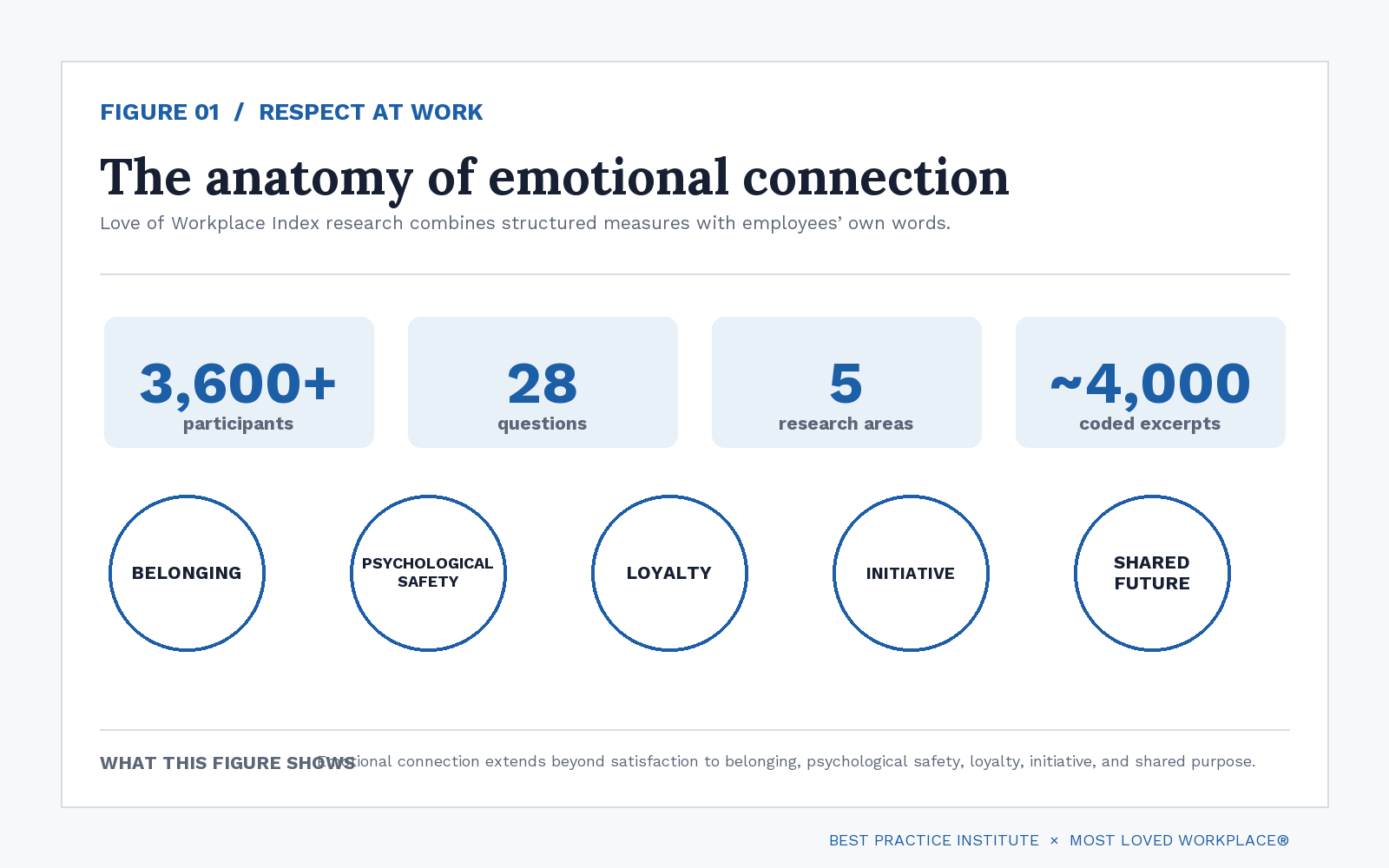
Figure 1
The anatomy of emotional connection
What this figure shows: Emotional connection extends beyond satisfaction to belonging, psychological safety, loyalty, initiative, and shared purpose.
Source: Carter and the Most Loved Workplace Research Team, 2023; Most Loved Workplace research deck, 2025. These figures describe BPI’s proprietary research methodology.
What the Research Says About Respect and Connection
Independent academic research supports the idea that emotional culture affects concrete workplace outcomes.
In a longitudinal study conducted in a long-term care setting, Sigal Barsade and Olivia O'Neill found that a culture of companionate love, defined through affection, compassion, caring, and tenderness, was associated with higher employee satisfaction and teamwork, lower absenteeism and emotional exhaustion, and better outcomes reported for patients and families. The setting matters, so the findings should not be treated as universal proof for every industry. They do show that the emotional content of culture can be studied and connected to outcomes (Barsade & O'Neill, 2014).
Respect also affects how people think together. Across four studies, Abraham Carmeli, Jane Dutton, and Ashley Hardin found that respectful engagement was indirectly related to creative behavior through better relational information processing at both the individual and team levels (Carmeli, Dutton, & Hardin, 2015). In practical terms, people are more willing to exchange and use information when their interactions preserve dignity.
Amy Edmondson's study of 51 work teams found that psychological safety was associated with learning behavior, and that learning behavior helped explain team performance. She defined psychological safety as a shared belief that a team is safe for interpersonal risk taking. She also made clear that psychological safety is grounded in mutual respect and trust. It is not an absence of standards or an expectation that everyone agree (Edmondson, 1999).
These findings matter because many organizations still treat emotion as the soft side of work and performance as the hard side. In real organizations, the two interact. People are less likely to report a risk, admit an error, challenge a weak idea, or ask for help when they expect embarrassment or punishment.
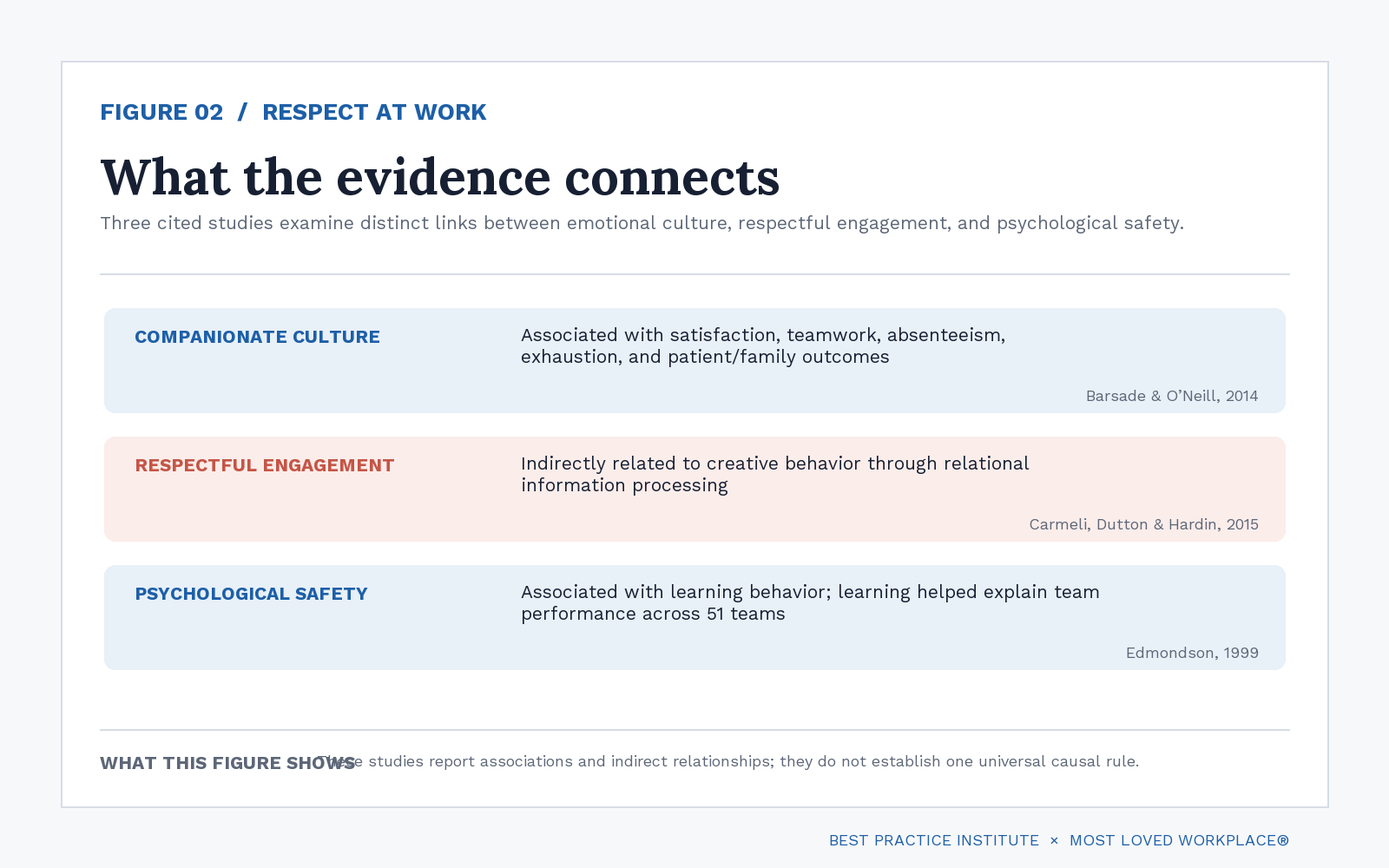
Figure 2
What the evidence connects
What this figure shows: Separate studies connect emotional culture, respectful engagement, and psychological safety with meaningful workplace outcomes, while stopping short of one universal causal claim.
Sources: Barsade and O’Neill, 2014; Carmeli, Dutton, and Hardin, 2015; Edmondson, 1999. The Barsade and O’Neill study was conducted in long-term care.
Why Respect Must Flow in Every Direction
Workplace relationships are reciprocal. Social exchange theory describes them as a series of interdependent interactions that can develop into trust, loyalty, and mutual commitment over time (Cropanzano & Mitchell, 2005). One person's behavior changes what the other person is willing to risk, contribute, or disclose.
The research on leader-member exchange makes this especially clear. A meta-analysis of 79 studies covering 85 independent samples found significant relationships between the quality of the leader-employee relationship and job performance, satisfaction with supervision, overall satisfaction, organizational commitment, role clarity, and turnover intentions. The authors also found that leaders and employees only moderately agreed on the quality of their relationship, which is a useful warning against relying on a manager's view alone (Gerstner & Day, 1997).
A 2024 meta-analysis based on 157 independent samples found that positive leader behavior, the broader relational and organizational context, and subordinate characteristics all contributed to subordinate-to-supervisor relational identification. That identification was associated with important employee attitudes and behavior (Zhong, Sluss, & Badura, 2024). The working relationship is shaped by both people and by the system around them.
Respect flowing upward does not mean employees must be deferential or silent. It means they tell the truth without trying to humiliate someone. They raise problems early, share the information a manager needs to make a sound decision, honor reasonable commitments, and disagree with the decision rather than attacking the person.
Respect flowing downward carries added obligations because managers control assignments, evaluations, pay recommendations, access, and opportunities. A manager who says, "My door is always open," has not done enough. In a study involving 3,149 employees and 223 managers, James Detert and Ethan Burris found that managerial openness was more consistently related to employee voice than transformational leadership, and that psychological safety helped explain the relationship. Employees watch whether managers listen, consider ideas fairly, and act on useful input (Detert & Burris, 2007).
Respect also has to move across the organization. Peer contempt, internal politics, information hoarding, and public shaming can destroy emotional connection even when the CEO communicates the right values. Culture lives in everyday exchanges among colleagues as much as it does in formal leadership messages.
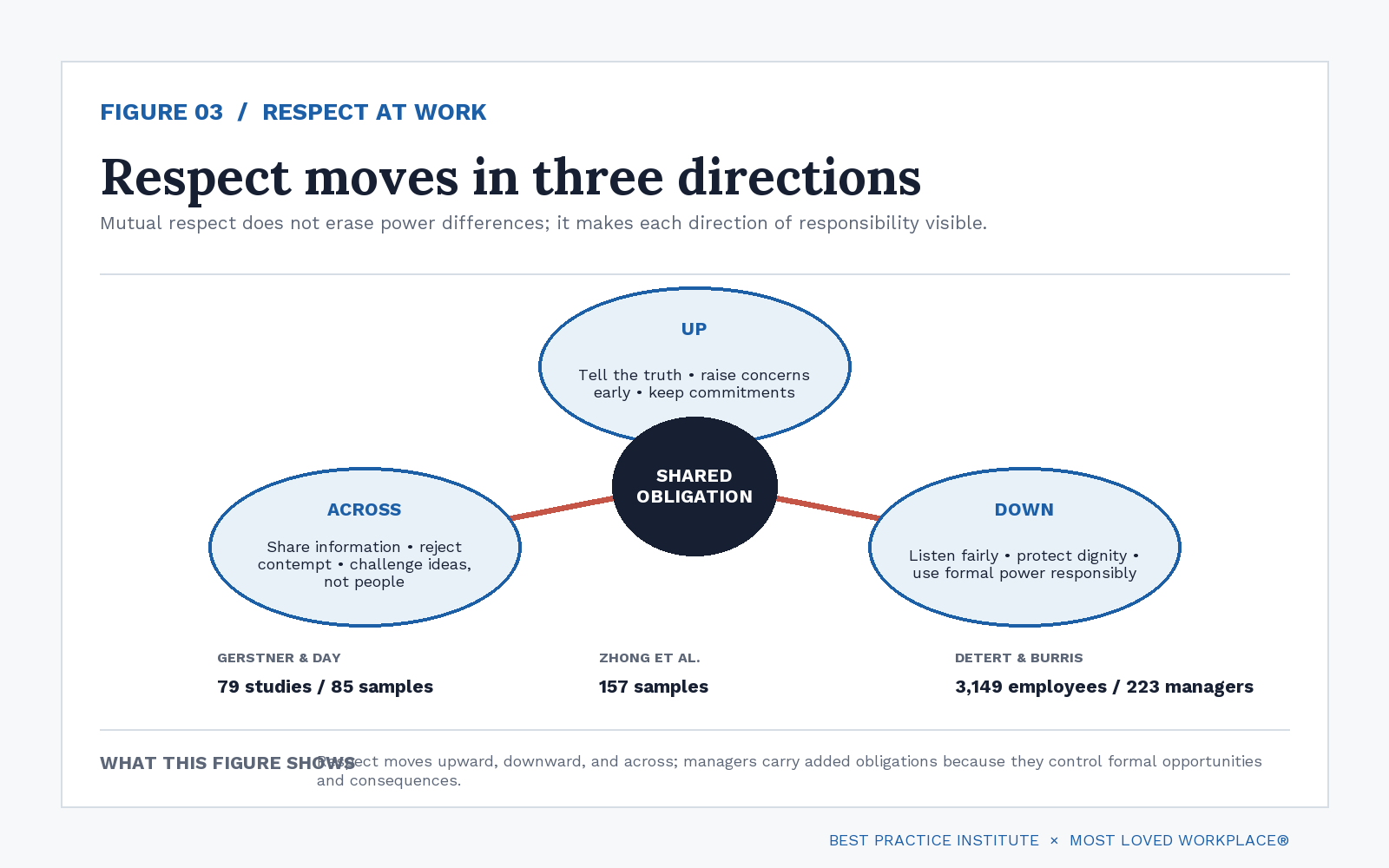
Figure 3
Respect moves in three directions
What this figure shows: Respect moves upward, downward, and across teams; managers carry added obligations because they control assignments, evaluations, pay recommendations, access, and opportunities.
Sources: Gerstner and Day, 1997; Zhong, Sluss, and Badura, 2024; Detert and Burris, 2007. Each sample belongs to a separate study; peer conduct reflects Louis Carter’s organizational observation.
Why Good Managers Must Be Retained Too
Managers are employees. Yet many employee-retention programs treat them as if they exist outside the employee experience, responsible for supporting everyone else while requiring little support themselves.
Managers also carry the organization's relationship with employees. Across three studies, perceived supervisor support contributed to employees' broader sense that the organization valued them and cared about their well-being. In the third study, that broader sense of organizational support accounted for the negative relationship between supervisor support and employee turnover (Eisenberger et al., 2002).
That is a costly blind spot. Harvard Business Review reported in 2023 that more than half of managers felt burned out, a slightly higher proportion than employees overall (Klinghoffer & Kirkpatrick-Husk, 2023). Gallup's 2026 State of the Global Workplace summary reported that falling manager engagement accounted for much of the broader decline in global engagement since 2023. Gallup also described managers as one of the primary ways employees experience the organization (Harter & Pendell, 2026).
There is a retention consequence as well. A four-wave study of 845 employees across 40 business units found that leader departures were associated with elevated unit-level staff turnover. That turnover was then associated with greater variation in leader-member relationships and more relationship conflict (Tremblay & Saint Fleur, 2026). One study should not be treated as the last word, but its findings match a practical reality: when a capable, trusted manager leaves, the organization can lose stability, knowledge, and other employees along with that person.
Retaining effective managers should therefore be part of the employee-retention strategy, not a lesser concern. This does not mean protecting managers who demean people or consistently fail. It means identifying managers who earn trust, helping them succeed, giving them manageable responsibilities, and responding when they are overloaded or treated abusively.
Senior leaders should ask managers the same kinds of questions they expect managers to ask their teams. Do you have the information and authority needed to do your job? Are expectations clear? Can you disagree safely? Are you receiving useful feedback? Is your workload sustainable? Do you feel respected by the people above you, beside you, and on your team?
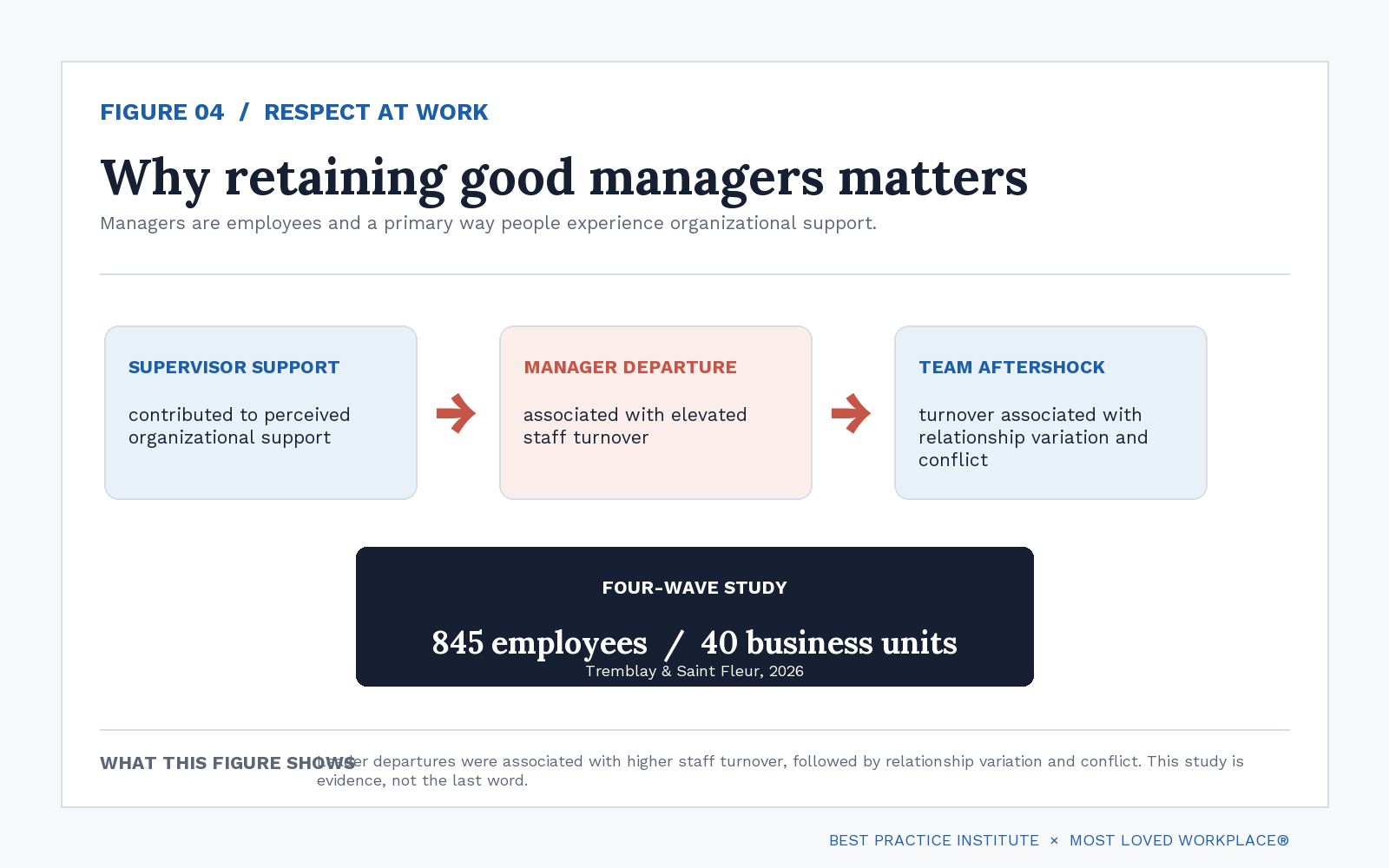
Figure 4
Why retaining good managers matters
What this figure shows: Managers carry relationships, knowledge, and stability; their support and departure are associated with consequences beyond a single role.
Sources: Eisenberger et al., 2002; Tremblay and Saint Fleur, 2026. The four-wave study is important evidence, not the last word or proof of universal causation.
What Mutual Respect Looks Like in Daily Work
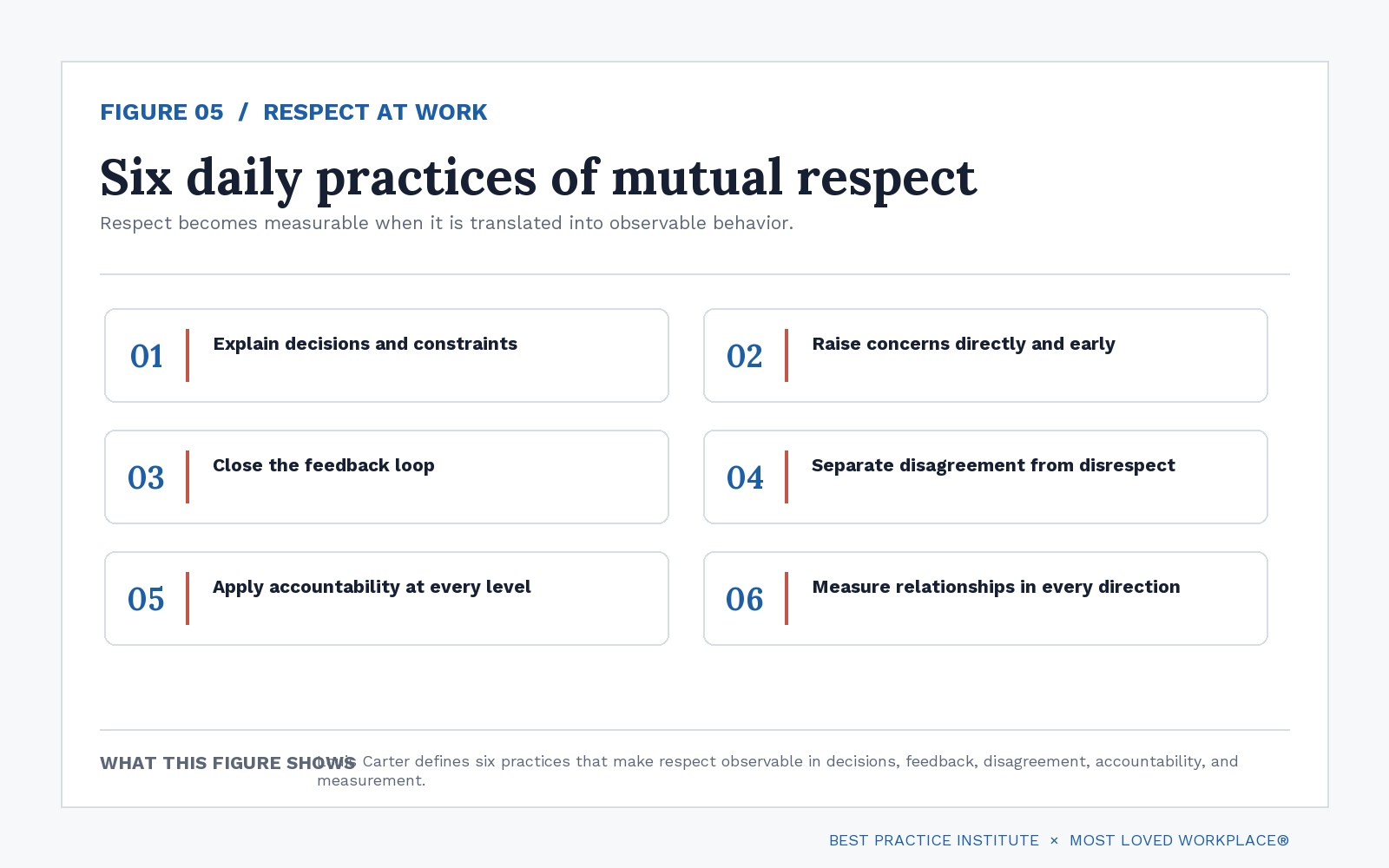
Mutual respect becomes real through observable behavior.
-
Leaders explain decisions and constraints. Employees may still disagree, but a candid explanation is more respectful than silence, spin, or a decision presented as inevitable when it was not.
-
Employees raise concerns directly and early. Waiting until frustration becomes public hostility helps no one. Candor is most useful when the person who can address the issue hears it in time.
-
Managers close the feedback loop. They explain what they heard, what will change, what will not change, and why. Asking for feedback and then disappearing damages trust.
-
The organization separates disagreement from disrespect. People should be able to challenge an idea, including a leader's idea, without ridicule or retaliation. The same standard should prohibit personal attacks directed at managers or peers.
-
Accountability applies at every level. Leaders are accountable for fair treatment and responsible use of power. Employees are accountable for conduct, performance, and honest communication. Senior executives are accountable for providing managers with enough support to lead well.
-
The company measures relationships in every direction. It should examine how employees experience managers, how managers experience senior leaders and their teams, and how coworkers treat one another. A single company-wide engagement score can hide serious local problems.
How Organizations Can Measure Respect and Emotional Connection
A useful culture assessment should combine quantitative measures with employees' own words. Scores reveal where a pattern may exist. Open-ended responses help explain what people are actually experiencing.
The questions should examine the entire system. Do employees feel safe giving managers bad news? Do managers receive clear direction and support from senior leadership? Can colleagues disagree without becoming personal? Are standards applied consistently? Do people at every level keep commitments and acknowledge mistakes?
Technology can help organize large amounts of feedback, but human judgment remains essential. In our Most Loved Workplace work, we analyze sentiment, emotion, topic, and theme because two comments that use similar words can communicate very different experiences. The 2023 white paper describes how our research team built that framework from manually coded employee feedback before applying machine learning to the task , per the Most Loved Workplaces profile.
The final step is the one organizations most often miss: act and report back. Measurement without visible follow-through teaches people that speaking honestly changes nothing.
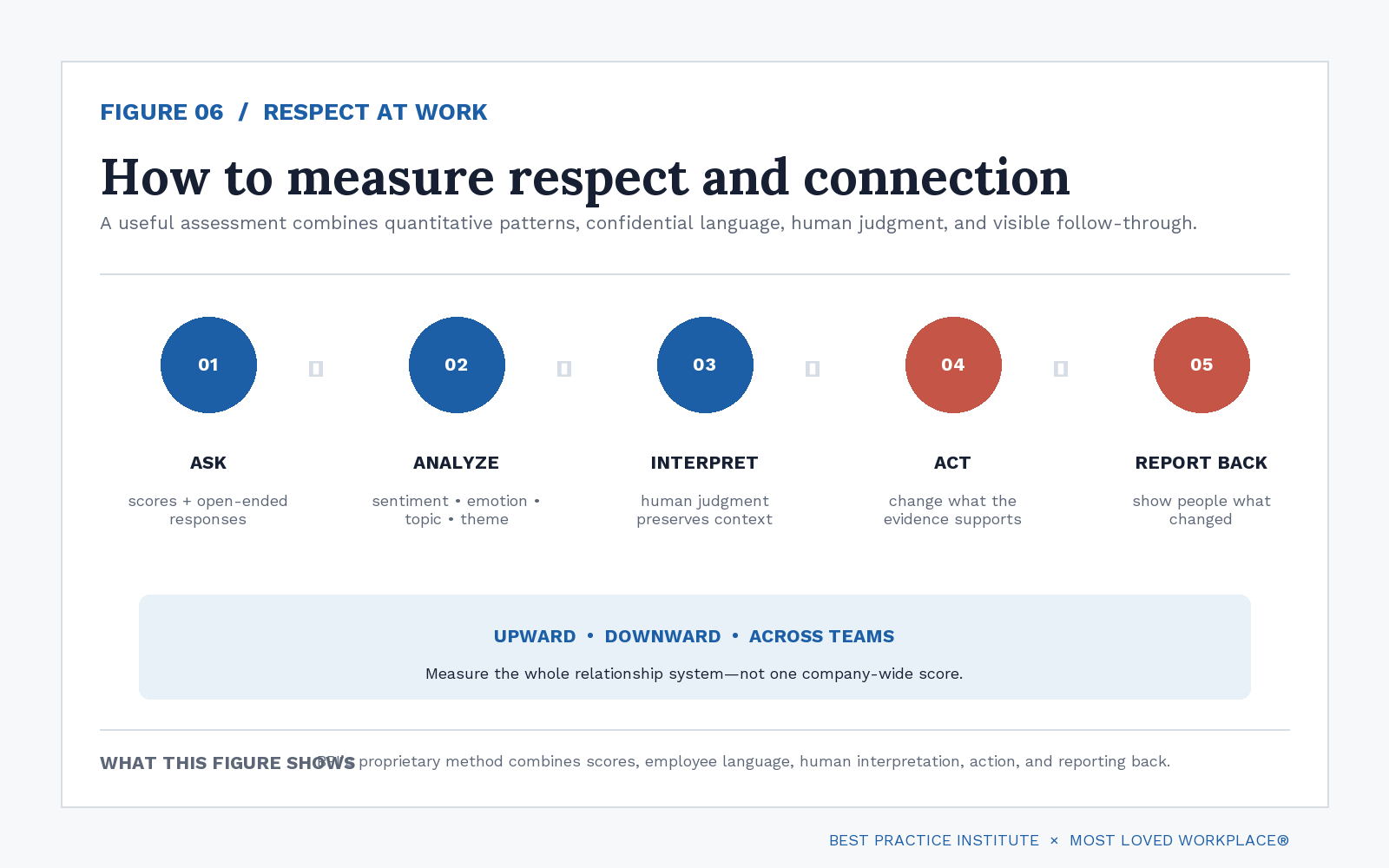
Figure 6
How to measure respect and connection
What this figure shows: A useful assessment combines scores and confidential employee language with human interpretation, action, and visible follow-through.
Methodology: Carter and the Most Loved Workplace Research Team, 2023. This visual describes BPI’s own measurement approach.
The Standard Leaders Should Set
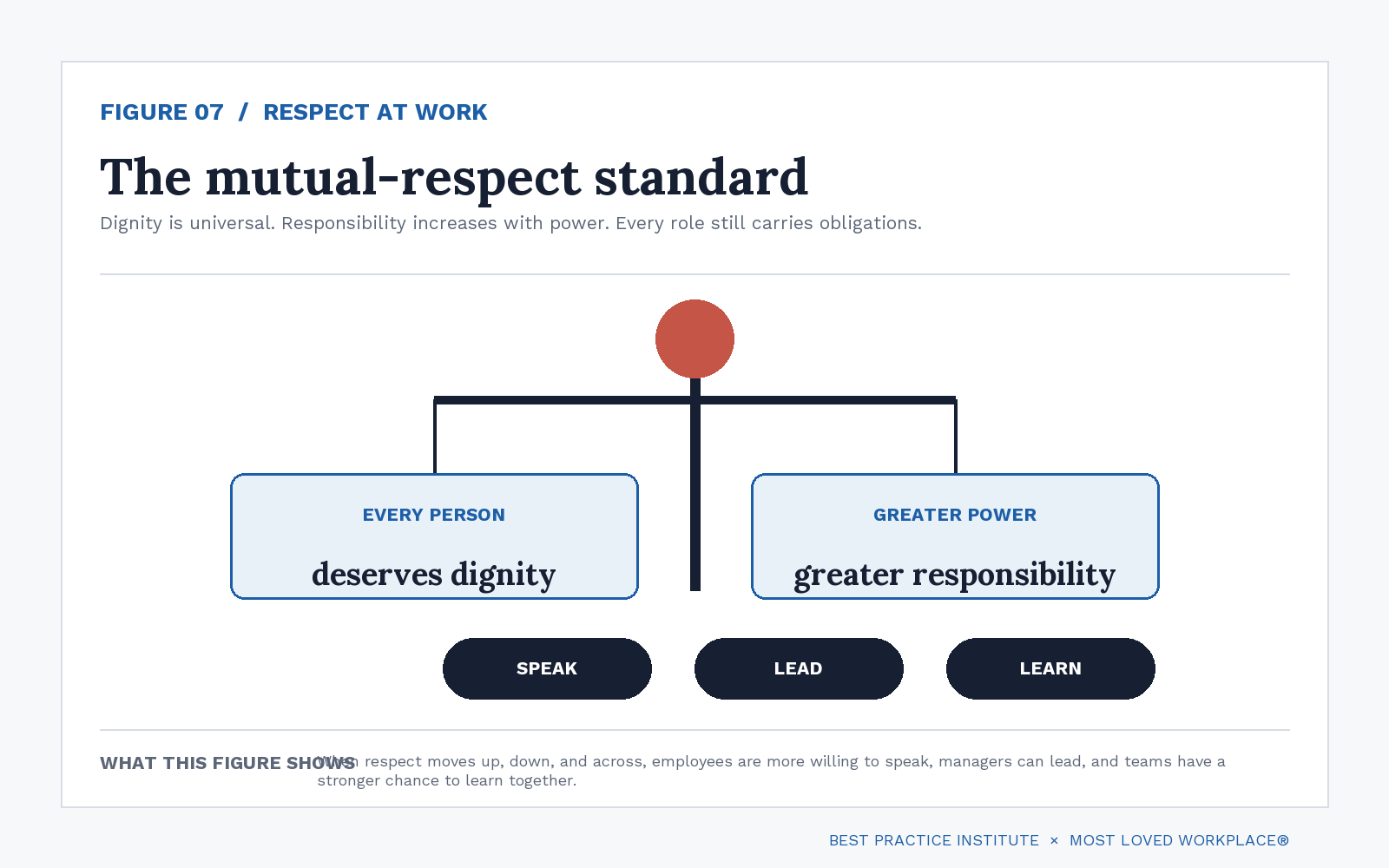
The standard I would set is simple. Every person deserves dignity, and every role carries obligations. Leaders have more power, so their responsibilities are greater. Employees still have an obligation to behave professionally and honestly.
When respect moves up, down, and across the organization, employees are more willing to speak, managers are better able to lead, and teams have a stronger chance of learning together. That is the foundation of emotional connectedness at work.
If you want to know whether employees and managers experience the same respect and emotional connection that leadership intends to create, start with the free CertCheck from Most Loved Workplace. It provides an initial view of how people experience your culture and where perception may differ across the organization: Start the free CertCheck.
About Louis Carter
Louis Carter is the founder and CEO of Best Practice Institute and Most Loved Workplace. He is an organizational psychologist, the creator of the Love of Workplace Index, and the author of In Great Company. His work focuses on emotional connectedness, leadership, workplace culture, and the conditions that help people do their best work.
References
Barsade, S. G., & O'Neill, O. A. (2014). What's love got to do with it? A longitudinal study of the culture of companionate love and employee and client outcomes in a long-term care setting. Administrative Science Quarterly, 59(4), 551-598. https://doi.org/10.1177/0001839214538636 Carmeli, A., Dutton, J. E., & Hardin, A. E. (2015). Respect as an engine for new ideas: Linking respectful engagement, relational information processing and creativity among employees and teams. Human Relations, 68(6), 1021-1047. https://doi.org/10.1177/0018726714550256 Carter, L., & Most Loved Workplace Research Team. (2023). Creating a happier more productive workforce: How Most Loved Workplace uses data and machine learning to drive change. Most Loved Workplace and Best Practice Institute. https://mostlovedworkplace.com/wp-content/uploads/2023/05/2_MLWP_Love-of-Workplace-Index-Whitepaper.pdf Cropanzano, R., & Mitchell, M. S. (2005). Social exchange theory: An interdisciplinary review. Journal of Management, 31(6), 874-900. https://doi.org/10.1177/0149206305279602 Detert, J. R., & Burris, E. R. (2007). Leadership behavior and employee voice: Is the door really open? Academy of Management Journal, 50(4), 869-884. https://doi.org/10.5465/amj.2007.26279183 Edmondson, A. (1999). Psychological safety and learning behavior in work teams. Administrative Science Quarterly, 44(2), 350-383. https://doi.org/10.2307/2666999 Eisenberger, R., Stinglhamber, F., Vandenberghe, C., Sucharski, I. L., & Rhoades, L. (2002). Perceived supervisor support: Contributions to perceived organizational support and employee retention. Journal of Applied Psychology, 87(3), 565-573. https://doi.org/10.1037/0021-9010.87.3.565 Gerstner, C. R., & Day, D. V. (1997). Meta-analytic review of leader-member exchange theory: Correlates and construct issues. Journal of Applied Psychology, 82(6), 827-844. https://doi.org/10.1037/0021-9010.82.6.827 Harter, J., & Pendell, R. (2026, April 7). Global employee engagement continues decline. Gallup. https://www.gallup.com/workplace/708071/global-employee-engagement-continues-decline.aspx Klinghoffer, D., & Kirkpatrick-Husk, K. (2023, May 18). More than 50% of managers feel burned out. Harvard Business Review. https://hbr.org/2023/05/more-than-50-of-managers-feel-burned-out Most Loved Workplace. (2025). Turning emotional connection into competitive advantage . Best Tremblay, M., & Saint Fleur, W. (2026). Leader departure and relationship dynamics in small business units. Small Group Research, 57(4), 571-604. https://doi.org/10.1177/10464964251372900 Zhong, Y., Sluss, D. M., & Badura, K. L. (2024). Subordinate-to-supervisor relational identification: A meta-analytic review. Journal of Applied Psychology, 109(9), 1431-1460. https://doi.org/10.1037/apl0001169
Quick answers
Get your free Opportunity Report
See your eligibility score, the certifications you may qualify for, and what candidates and AI search engines find when they look you up. Takes about 60 seconds.
Curious what candidates see when they ask AI about Best Practice Institute?
Run a free AI visibility scan and see exactly how AI assistants describe your employer brand — and what they get wrong. Find out in 60 seconds.
Published in The Workplace Report by Best Practice Institute. See our methodology.