The Cost of Ignoring Workplace Culture: Why Becoming a Most Loved Workplace® Matters
The cost of employee turnover reaches beyond hiring. Louis Carter explains how workplace culture connects retention, productivity and customer experience.

Ignoring workplace culture shows up as measurable business costs: avoidable employee turnover, harder recruiting, lost productivity and weaker customer relationships. There is no honest universal percentage, so employers should calculate their own replacement costs, measure the employee experience and fix specific problems before pursuing recognition.
- The cost of employee turnover includes separation, recruiting, vacancy coverage, onboarding and ramp-up productivity loss — not just the recruiting invoice.
- Repeated departures from the same manager, team or tenure stage signal a workplace condition, not a hiring problem.
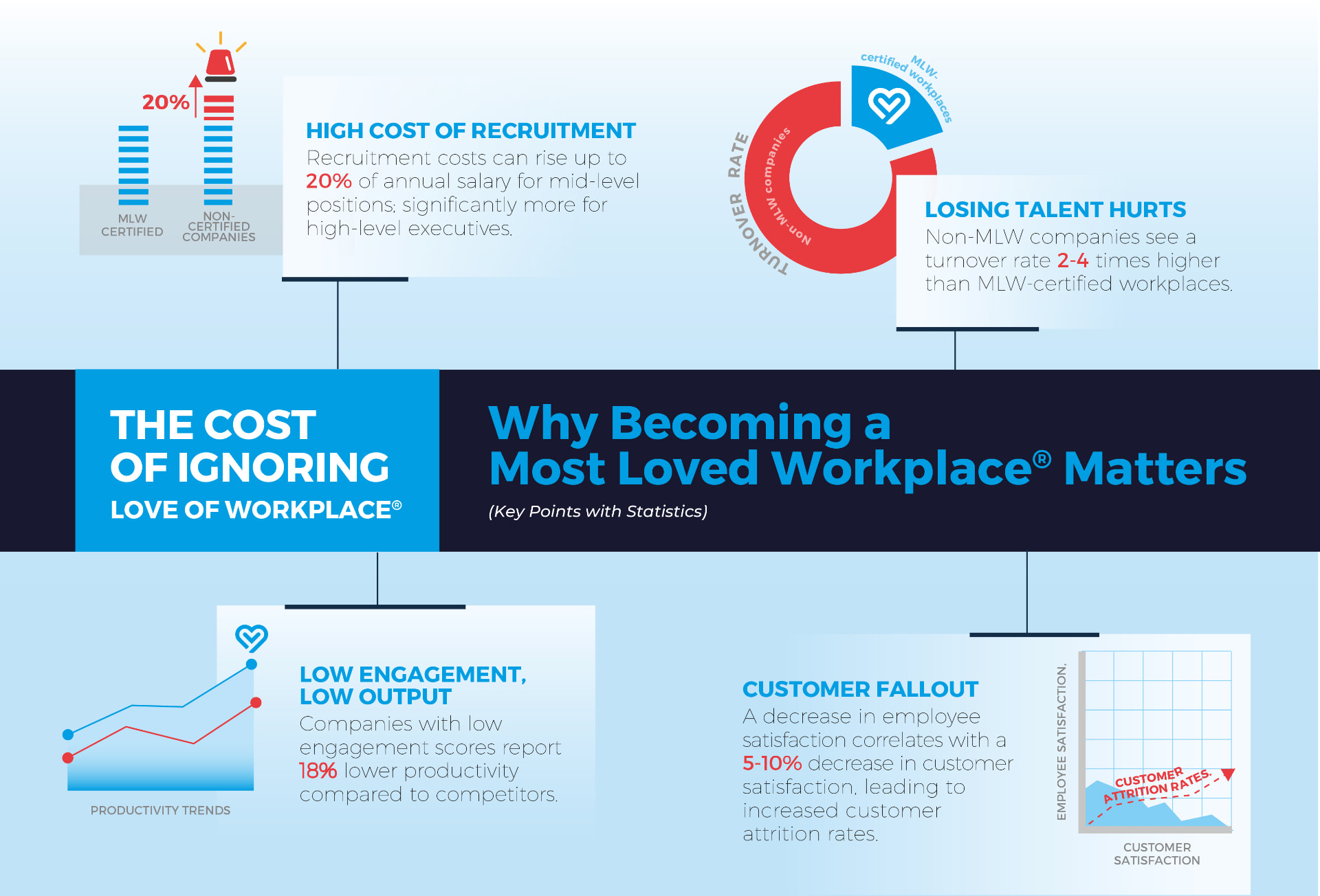
- Gallup’s Q12 meta-analysis links top-quartile engagement with 18% higher sales productivity and 10% higher customer loyalty — associations, not certification guarantees.
- Certification should follow evidence: measure the employee experience first, fix a specific problem, then communicate only what is true.
- A preliminary Opportunity Report is a starting conversation, not a certification decision.
The bill does not arrive under “culture.” It arrives as employee turnover, repeated hiring, lost productivity and customers who stop coming back.
The cost of employee turnover is not just the price of replacing someone. It includes recruiting, onboarding, vacancies, lost knowledge and the time it takes a new employee to become effective. When the workplace itself contributes to people leaving, those costs can become a recurring business problem rather than an occasional hiring expense.
That is why I reject the idea that love of workplace is a soft issue.
Get your free Opportunity Report
See your eligibility score, the certifications you may qualify for, and what candidates and AI search engines find when they look you up. Takes about 60 seconds.
People experience your company from the inside before customers experience it from the outside. They know whether colleagues cooperate, whether leaders keep their word and whether doing good work actually matters. Those conditions can affect how work gets done and how customers are treated.
A workplace people love is not an organization without conflict or demanding goals. It is one where people have reasons to commit to the work, the organization and one another.
Becoming a Most Loved Workplace® should mean earning recognition for those conditions. Buying a package or putting a badge on a careers page cannot create them.
What does poor workplace culture actually cost a business?
Poor workplace culture can contribute to avoidable turnover, higher recruiting demands, operational friction and inconsistent customer service. The size of that cost depends on the company, the role and the underlying problem. There is no honest universal percentage that tells every employer what it is losing.
The useful question is not, “What does culture cost?”
It is, “Where are we already paying for the conditions we have failed to address?”
Start with four places: retention, recruitment, productivity and customer relationships.
1. Employee turnover costs more than the next hire
When someone leaves, a company can lose more than a person on its payroll. It can lose relationships, judgment, institutional knowledge and the ability to do work without constant explanation.
The recruiting invoice is visible. The manager spending evenings interviewing is less visible. So is the colleague covering two jobs, the customer repeating a problem to a new account contact or the project that stalls while a replacement learns the business.
Not every departure is a culture failure. People relocate, change careers and leave for reasons an employer cannot control. Some turnover is appropriate. Keeping someone in the wrong role is not a retention success.
But repeated, avoidable departures deserve investigation. If people keep leaving the same manager, team or stage of their employment, another recruiting campaign will not resolve the cause.
How to calculate the cost of employee turnover
Build a replacement-cost estimate from your own records:
Cost per departure = separation costs + recruiting costs + vacancy coverage + onboarding and training + documented productivity loss.
For a CFO or CHRO, that means accounting for:
- Separation: administration and other applicable departure expenses.
- Recruiting: advertising, agency fees and staff time spent sourcing and interviewing.
- Vacancy coverage: overtime, temporary help and work reassigned while the role is open.
- Onboarding: training, equipment setup and time contributed by managers and colleagues.
- Productivity loss: the gap between expected contribution and actual contribution during the vacancy and ramp-up period.
Keep the calculation disciplined. Do not count the same lost output twice or treat every vacant-role salary dollar as a loss. Separate documented expenses from estimates, and use ranges where the evidence is uncertain.
Then ask what share of those departures might have been prevented. That is the business case for improvement, not an inflated industry average.
A worked example, for illustration only: a 250-person company losing 30 employees a year, at $15,000–$35,000 in combined separation, recruiting, vacancy, onboarding and ramp-up costs per departure, carries an annual exposure of roughly $450,000–$1,050,000. Preventing one departure in five changes that number materially. Run the same exercise with your own figures.
2. Recruitment becomes harder when the employee story is not credible
A careers page can promise opportunity. Employees determine whether that promise survives contact with reality.
Candidates can encounter public reviews, employee stories, job advertisements and answers generated by search tools. These sources may disagree. A polished message cannot remove that contradiction by itself.
If the experience does not support the employer story, a company may have to work harder to attract people, reassure them and persuade them to accept an offer. The cost can show up in recruiting effort, time to fill or compensation pressure. Each needs to be measured rather than assumed.
I would rather see an employer make a narrower promise it can prove than a sweeping promise its own employees would challenge.
Most Loved Workplace® certification can provide a recognizable signal when it has been earned. It is not a guarantee of more applications, better hires or favorable AI search answers.
The underlying task remains the same: create an employee experience worth describing, then make the evidence accessible.
3. Workplace friction can drain productivity
A person can stay employed and still lose the conditions that help them contribute.
Think about work that slows down because departments will not cooperate. Decisions that stall because people do not know who owns them. Employees who stop raising problems because speaking up leads nowhere.
These are operating problems. They should not disappear into a vague conversation about morale.
Gallup’s Q12 meta-analysis reports median differences between business units in the top and bottom quartiles of employee engagement: 18% in productivity measured through sales and 14% in productivity measured through production records and evaluations.
Those findings concern Gallup’s measure of employee engagement. They are not Most Loved Workplace® certification results, and they do not establish that recognition alone causes productivity to increase.
The distinction matters. So does the business implication: employee experience and business performance should not be managed as unrelated subjects.
Leaders need to identify the conditions that make contribution easier or harder. Better collaboration, clearer direction and mutual respect are not substitutes for performance. They can help make performance possible.
4. Customers can feel the consequences
Your customer does not see your internal survey results. Your customer sees whether someone listens, takes responsibility and follows through.
Poor handoffs, inconsistent answers and unresolved problems can damage a relationship. A dissatisfied employee does not automatically create a dissatisfied customer. But the conditions employees work within can shape the service customers receive.
The same Gallup meta-analysis reports a 10% median difference in customer loyalty/engagement between top- and bottom-quartile business units.
That is an association across the business units studied, not a promise that improving culture will increase a particular company’s customer satisfaction or revenue by 10%.
My point is simpler: when leaders want more customers and stronger repeat business, they should examine the employee conditions behind the customer experience, not just the marketing in front of it.
Track customer retention, complaints, repeat purchases and service recovery alongside employee measures. Look for patterns. Then investigate them before declaring a cause.
Love of workplace is not the opposite of accountability. It is a reason to care about what accountability produces.
What does becoming a Most Loved Workplace® require?
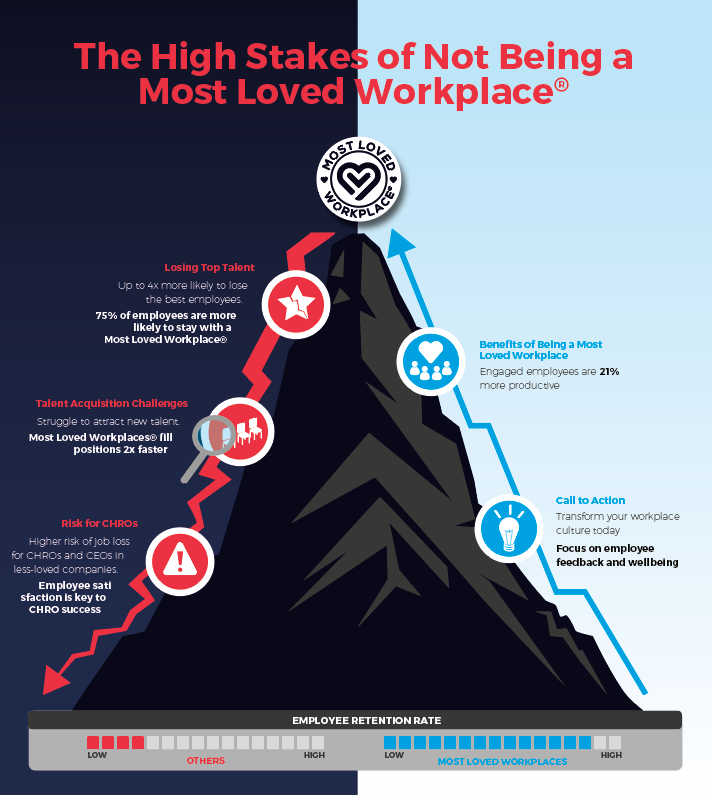
Most Loved Workplace® is not a label an employer can credibly give itself without employee evidence. Certification follows an evaluation process; participation or payment does not guarantee recognition.
At Best Practice Institute, the LOWI, or Love of Workplace Index, is the BPI-developed employee survey used to assess emotional connectedness at work.
The SPARK Model organizes the conversation around five dimensions:
- Systemic Collaboration: cooperation built into how work happens, rather than depending on individual goodwill.
- Positive Vision for the Future: a credible direction employees can see themselves contributing to.
- Alignment of Values: consistency between what the organization says and what it does.
- Respect: human dignity and mutual respect expressed through everyday behavior.
- Killer Achievement: meaningful results that people are proud to help produce.
These dimensions make culture more specific. Instead of asking leaders to “improve morale,” they help identify what needs attention.
A team may believe in the company’s future but struggle with collaboration. Employees may feel respected yet see a gap between stated values and actual decisions. Different problems require different responses.
The purpose is not to manufacture favorable answers. It is to understand the experience and act on it.
What should a CEO or CHRO do next?
Start with evidence before recognition.
Five questions worth answering honestly:
- Do we know our voluntary turnover by manager, team and tenure stage — or only as one company-wide number?
- Can we name the last three problems employees raised and what happened to each?
- Would our own employees repeat the promises on our careers page?
- Do customers experience the same handoffs and follow-through we claim internally?
- If we earned recognition tomorrow, would the employee evidence behind it survive scrutiny?
Measure the employee experience
Give employees a way to describe how work actually feels. Protect confidentiality and explain how findings will be used. Do not confuse a leadership presentation with employee evidence.
Connect the findings to business outcomes
Compare patterns with voluntary turnover, recruiting demands, operational delays and customer issues. Use comparable periods and account for other changes in the business. A correlation is a starting point for investigation, not proof of causation.
Fix a specific problem
Choose an issue people can recognize: an obstructive handoff, unclear responsibility, inconsistent management behavior or an unfulfilled commitment. Assign an owner and a way to judge whether the change helped.
Communicate what is true
Explain what employees said, what leadership is doing and what remains unresolved. If certification is earned, communicate it accurately. Do not promise customer growth, talent outcomes or recognition that the evidence does not support.
The next step can be a preliminary Opportunity Report and a conversation about the organization’s needs. A preliminary score is not certification, and a sales conversation is not a certification decision.
Request your Opportunity Report.
The cost exists whether you name it or not
A company can decide not to pursue certification. That does not establish that its culture is poor.
A company can also decide not to examine its workplace. That does not make the consequences disappear.
The difference matters. This is not an argument that every uncertified employer is failing. It is an argument that leaders cannot afford to treat the employee experience as disconnected from business performance.
If people do not believe in the future, cannot work together or do not see values reflected in decisions, there is something to address. If customers keep encountering the consequences, there is something to measure.
The badge is not the business case. The workplace is.
Quick answers
Get your free Opportunity Report
See your eligibility score, the certifications you may qualify for, and what candidates and AI search engines find when they look you up. Takes about 60 seconds.
Curious what candidates see when they ask AI about your company?
Run a free AI visibility scan and see exactly how AI assistants describe your employer brand — and what they get wrong. Find out in 60 seconds.
Published in The Workplace Report by Best Practice Institute. See our methodology.