Why fragmented HR, marketing, and talent teams are costing you candidates — and what a connected, proof-driven culture signal changes.
Most employers are telling a culture story. Very few are proving it. The difference between the two is costing them their best candidates before the first interview ever happens.
When a candidate lands on your careers page, follows your company on LinkedIn, or sees your open role on Indeed, they are not reading your job description. They are reading your culture. They are asking one question before they ever click apply: Do I believe you?
For the majority of organizations, the honest answer from the candidate's perspective is: not really. Not because the culture is bad. But because the signals you send are fragmented, indirect, and impossible to verify. Your HR team knows what your employees feel. Your marketing team knows how to craft a message. Your employer branding team knows what to say about the company. But these three functions are rarely talking to the same source of truth, and candidates know it.
This is the credibility gap at the center of most employer brand strategies today, and it is costing organizations their pipeline.
The Fragmented State: How Most Employers Actually Operate
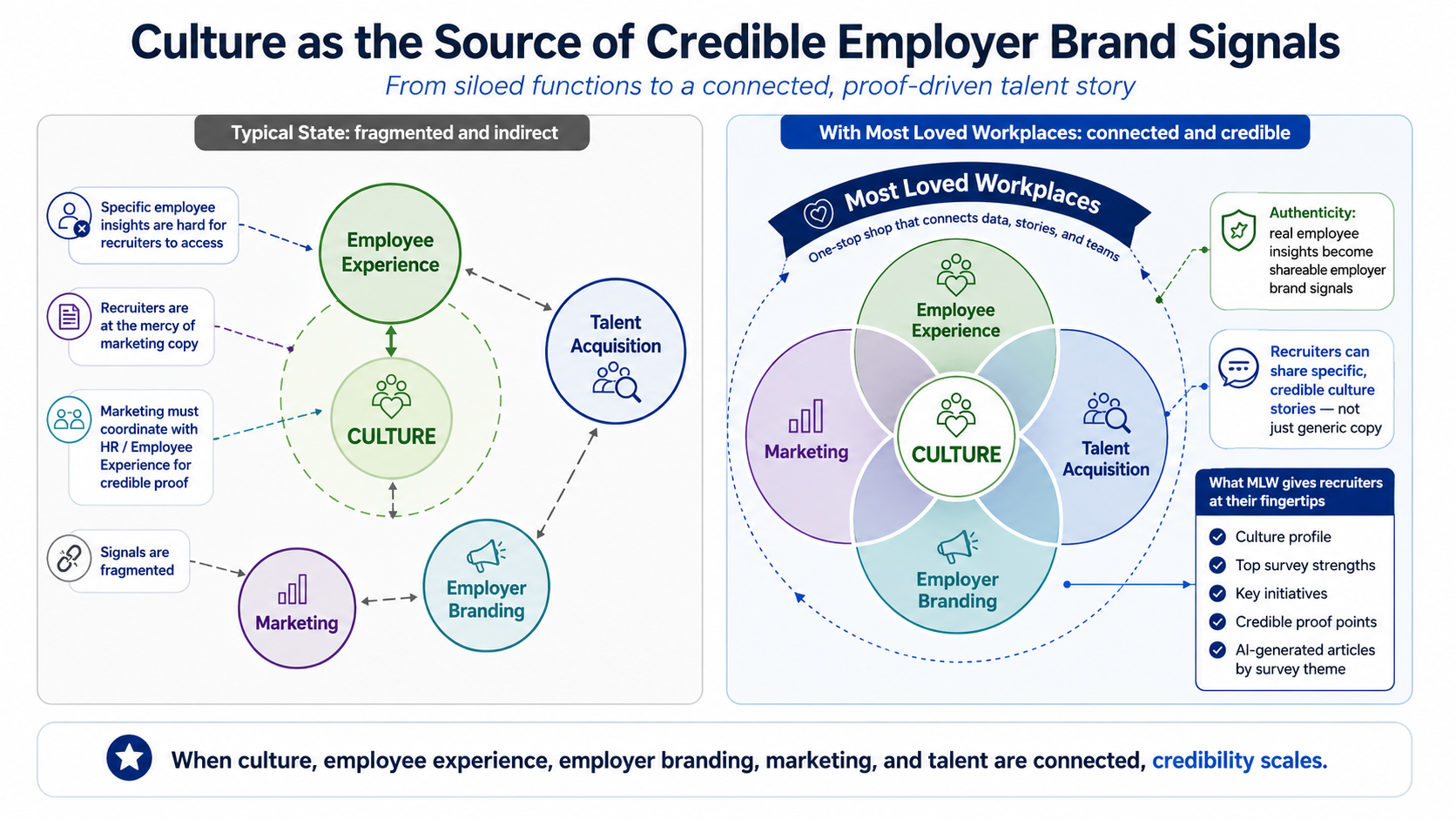
The diagram I work with when I talk to CHROs and Heads of Talent Acquisition lays this out plainly. In the typical state, culture sits at the center of the organization, but it is effectively walled off from the functions that need it most.
Typical state — fragmented and indirect:
- Employee insights are hard for recruiters to access
- Recruiters rely on marketing copy, not real proof
- Marketing must coordinate with HR for every credible claim
- Employer brand signals are siloed and inconsistent
With Most Loved Workplaces — connected and credible:
- Real employee insights become shareable brand signals
- Recruiters share specific, credible culture stories
- One platform connects data, stories, and teams
- A culture profile sits at every recruiter's fingertips
Recruiters are at the mercy of whatever marketing copy was approved six months ago. Marketing cannot move fast enough to keep pace with what HR is actually learning from employees. Employer branding sits somewhere in between, trying to synthesize a message from sources that do not sync.
The result is a culture story that feels generic. Because it is.
"When employee experience, talent acquisition, marketing, and employer branding all operate from the same real-time culture data, credibility stops being a talking point. It becomes the proof."
What Candidates and Recruiters Actually Need
Here is what I hear in nearly every conversation with talent acquisition leaders right now: their recruiters are articulate, motivated, and genuinely believe in the company's culture. But when a finalist candidate asks them to be specific — to go beyond the talking points — they reach for the same generic answers that every other employer is giving.
That is not a training problem. It is a data access problem.
The information that would make a recruiter's pitch genuinely compelling sits inside the employee experience data that HR is collecting, analyzing, and discussing internally. It never gets to the person who needs it at the exact moment it matters most, which is during a talent conversation with a candidate who has options.
What recruiters need at their fingertips is not more marketing collateral. It is:
- A living culture profile that reflects what employees actually say, not what leadership hopes they say
- The organization's top survey strengths, stated in plain language, sourced from validated research
- Key initiatives underway that demonstrate the company is acting on what employees report
- Credible proof points, including third-party certification, that a candidate can verify independently
- Content that connects the culture story to specific roles, teams, and values — not just the enterprise brand
When a recruiter can speak to these things specifically, the conversation changes. The candidate stops evaluating your employer brand. They start evaluating the role.
Why the Research Validates This Approach
The Most Loved Workplaces certification process, built on the Love of Workplace Index developed by Best Practice Institute, has now validated this across more than 1,800 certified organizations representing 2.8 million surveyed employees, with a reliability alpha of .95.
- 2.8M employees surveyed across certified organizations
- 1,800+ companies certified across industries
- 48% lower turnover among certified organizations
- 4× higher performance outcomes reported
The finding that shapes everything else in this research is this: emotional connectedness — not engagement scores, not satisfaction ratings — is the primary driver of whether employees stay, perform at their peak, and become advocates for the organization externally. When that connectedness erodes, typically between year one and years three to four, the employer brand story collapses from the inside out.
The organizations that arrest that erosion are the ones that treat culture data not as an HR reporting function, but as a living, shareable signal that flows across every team touching talent.
The Connection Model: What Changes When Culture Is the Hub
The right-hand side of the diagram I share with prospects shows what this looks like when it works. The four functions — Employee Experience, Talent Acquisition, Marketing, and Employer Branding — are no longer orbiting culture separately. They overlap. They share a data source. They speak from the same proof.
This is not a theoretical organizational redesign. It is a platform question. Who gives these four functions a shared language and a shared source of truth about what the culture actually is, right now, verifiable by an outside candidate?
That is what Most Loved Workplaces certification delivers in practice. The certification process surfaces the culture data. The platform makes it shareable across teams. The credential, featured in The Wall Street Journal, The Economist, and across major media, gives candidates a way to verify the claim independently.
Authenticity stops being a brand value. It becomes a proof point anyone can look up.
The MLW Operating System: Proof → Activation → Discoverability
CertCheck and Visipage are not separate companies or sub-brands. They are two layers of one platform — the Most Loved Workplace® Operating System — built and operated by Best Practice Institute. One credential, one source of truth, one brand. Three layers that turn culture proof into something candidates can find, verify, and act on.
                ┌────────────────────────────────────────┐
                │     MOST LOVED WORKPLACE® by BPI       │
                │       (one brand · one platform)       │
                └────────────────────────────────────────┘
                                  │
        ┌─────────────────────────┼─────────────────────────┐
        ▼                         ▼                         ▼
   ① PROOF                  ② ACTIVATION              ③ DISCOVERABILITY
   MLW Certification        MLW CertCheck™            MLW Visipage™
   The credential           The operating layer       The AI-visibility layer
Layer 1 — Proof · Most Loved Workplace® Certification
The third-party-validated credential, grounded in the SPARK model and the Love of Workplace Index™ (1,800+ companies, 2.8M employees, .95 reliability). Why it matters: gives HR, marketing, and talent one defensible proof point instead of three competing stories. mostlovedworkplace.com
Layer 2 — Activation · MLW CertCheck™
MLW CertCheck™ (certcheck.mostlovedworkplace.com · see plans) turns the certification into a live employer-brand operating system every recruiter, hiring manager, and marketer can run from on day one.
- A public, 20-section MLW company profile — culture values, SPARK results, employee testimonials, love metrics, leadership, benefits, interview tips, FAQ. One verified source of truth.
- Branded job distribution to Indeed, Talent.com, ZipRecruiter, Jooble, and Google Jobs — with Schema.org JobPosting markup and MLW certification badges, SPARK scores, and testimonials baked into every listing.
- Seven embeddable MLW widgets (Profile Summary, Active Jobs, Testimonials, SPARK Scorecard, Love Stats, Industry Benchmark, Regional Benchmark) — drop them into any careers page or ATS.
- An MLW AI content engine that writes SEO-optimized employer-branding articles and social posts from your SPARK scores, testimonials, and roles — not generic templates.
- A career-page toolkit — verified MLW trust seals, ATS-compatible job badges (Greenhouse, Lever, Workday), QR codes, email-signature badges, comparison cards.
- Competitive intelligence — industry and regional benchmarking, SPARK Five-Pillar diagnostics, AI-analyzed Love Signals, and an ROI calculator.
- A self-serve dashboard — profile editor, article and job management, role-based team access, candidate-leads tracking, engagement analytics.
The shift: MLW certification stops being a badge you collect and becomes a system your whole revenue-and-recruiting org runs on.
Layer 3 — Discoverability · MLW Visipage™
Job seekers and executive candidates increasingly start in ChatGPT, Perplexity, Gemini, Grok, and Google AI Overviews — not on a careers page. If you are invisible there, your employer brand never gets the chance to be evaluated. MLW Visipage™ (visipage.ai) is the AI-visibility layer that makes the company and its leaders the answer AI models return.
- AI-powered profile generation for the company and its key leaders — structured, schema-rich, source-verified.
- Always-on distribution of authoritative content across high-authority partner sites so LLMs cite you, not guess at you.
- An AI Discoverability Score — a proprietary measure of how well ChatGPT, Perplexity, Gemini, and Grok find and represent you, tracked over time.
- AI mention monitoring & attribution — see what each model says about you, which articles they cite, and how sentiment is trending.
- Competitive AI benchmarking — measure your visibility directly against your hiring competitors in the models candidates actually ask.
The shift: your culture proof does not stop at your careers page. It travels into the AI surfaces where the next generation of candidates forms a first impression.
Why one system, not three tools
Fragmented HR, marketing, and talent stacks created the credibility gap this article opens with. Three vendors, three dashboards, three stories. The MLW Operating System collapses that into one credential, one platform, one brand: Most Loved Workplace® provides the proof, MLW CertCheck™ activates it across every recruiting surface, and MLW Visipage™ carries it into the AI layer where modern candidates search. Buyers, candidates, and analysts see a single MLW brand across every touchpoint — not a constellation of disconnected logos.
A Note on Timing: Why This Matters More Right Now
The labor market has shifted. Top candidates have more information, more options, and less patience for employer brand claims that do not hold up. The companies winning the most talented people right now are not the ones with the biggest brand budgets. They are the ones who can prove the culture claim in 30 seconds, from a third party, with data their candidate can verify before the first interview.
That is the bar. The organizations that meet it are the ones treating culture as a shared, certified, shareable asset across every function that touches talent. The ones that do not are losing finalists they should have closed.
What This Looks Like in Practice
For the leaders I work with, this shows up as three concrete shifts:
- A single source of truth for culture. One certified, research-backed profile that HR, marketing, talent acquisition, and employer branding all draw from. No more conflicting decks.
- Recruiters armed with specifics, not slogans. Every recruiter has access to current strength areas, employee voice, and credible proof points they can speak to with a finalist candidate.
- A verifiable third-party credential the candidate can look up. Not a self-published award. A research-validated certification, distributed across high-trust media, that the candidate can find independently.
When these three shifts happen together, employer brand credibility stops being a marketing function. It becomes a cross-functional operating model — one that closes finalists, retains them past the year-three drop-off, and turns them into the next generation of advocates.
That is the gap we close at Best Practice Institute, and that is what Most Loved Workplaces certification was built to deliver.